


The Global Music Industry Is Building AI Rights Infrastructure—Jamaica Cannot Afford to Arrive Late


New international work on attribution, fingerprinting, watermarking and AI training transparency suggests that accurate catalogue data may determine whether creators are licensed or disappear from the value chain.
Editorial verification: A new international AI infrastructure initiative launched in 2026 is bringing together creators, rights holders, technology companies and technical experts around data identification, attribution, watermarking, fingerprinting and rights management. The 2026 global recorded-music industry report also calls for AI developers to obtain authorisation before using protected music, maintain records of training material and provide transparency around AI-generated content.
The central music-industry battle surrounding artificial intelligence is moving beyond the question of whether generative systems should use copyrighted music without permission.
The next fight will concern infrastructure.
Who can identify a recording?
Who owns it?
Which performer appeared on it?
Who wrote the composition?
Which company controls the master?
Can an AI developer discover that information quickly enough to obtain a licence?
And can a rights holder prove that a recording entered a training dataset?
International copyright and music organisations are increasingly focused upon the technical systems required to answer those questions.
Current initiatives are examining identification, attribution, fingerprinting, watermarking and rights-management infrastructure as the creative industries attempt to develop workable relationships with artificial intelligence.
This development has enormous consequences for Jamaican music.
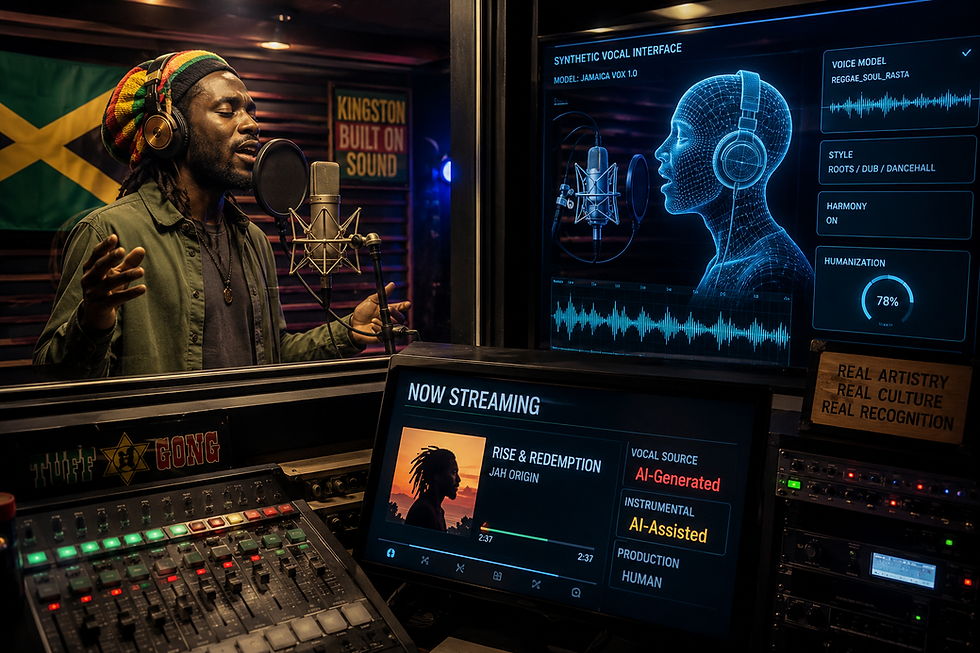
Reggae, dub, dancehall and sound-system culture have influenced global popular music for decades. The recordings documenting that history are distributed across major labels, independent producers, family estates, personal archives and defunct companies.
Some catalogues are organised professionally.
Others are not.
A recording may exist on streaming services while its writer information remains incomplete. A producer may own the master but lack digitised contracts. Another song may have several conflicting claims surrounding its ownership.
These problems existed before artificial intelligence.
AI increases their urgency because catalogue data can now determine whether a rights holder participates in a new licensing economy.
A technology company attempting to build a licensed model needs machine-readable information. If ownership cannot be identified, the work may be difficult to licence properly.
At the same time, a creator attempting to prove unauthorised use needs reliable evidence showing what was recorded, when it was created and who controlled the rights.
This means that metadata, traditionally treated by many artists as administrative paperwork, is becoming part of creative-economic infrastructure.
The international industry is also pushing for AI developers to disclose the material used to train models and for AI-generated output to be identified transparently.
Such requirements would significantly strengthen the negotiating position of creators, but only when creators themselves possess sufficiently organised catalogues to establish their claims.
Jamaica needs an AI-ready national music-rights infrastructure project.
This should not mean creating one government-controlled database claiming ownership over private music.
It should mean developing compatible systems through which authorised rights information can be verified and exchanged. The project should begin with foundational catalogues.
Producers, studios, publishers, musicians and estates associated with ska, rocksteady, reggae, dub and early dancehall should be offered technical assistance to digitise contracts, identify masters and document participants.
The work becomes more urgent with each death of a foundational creator.
Once knowledge disappears, reconstructing ownership becomes expensive and sometimes impossible.
Performers’ rights must be included alongside songwriter copyright.
AI systems can imitate voices and performance styles without copying a specific finished song. Contracts therefore need explicit language addressing digital replicas, model training and synthetic performance.
Fingerprinting technology represents another priority.
Jamaican collective-management organisations and industry associations should eventually possess access to tools capable of identifying catalogue usage across digital platforms and emerging AI services.
Small creators cannot individually audit global technology systems.
Collective technical capacity will be necessary.
The country should also participate actively in international standard-setting. Global technical rules designed entirely by multinational technology companies and large rights owners may not reflect the realities of independent music economies.
Jamaica’s cultural influence gives it a legitimate place at that table.
African music markets face similar challenges.
Afrobeats, amapiano, highlife, bongo flava and other genres are increasingly valuable to global technology systems, but rights infrastructure varies widely across territories.
Caribbean and African organisations should consider joint advocacy around training transparency, voice rights and cultural attribution.
AI does not automatically threaten Jamaican music.
Licensed generative tools could support restoration, remixing, education and new forms of authorised fan interaction.
The danger is entering that market with culturally valuable catalogues but weak documentation.
Jamaica has already experienced versions of this problem throughout recorded-music history: global influence without proportional economic capture.
Artificial intelligence should not become the newest chapter.
The music exists.
The creativity is undeniable.
Now the ownership data must become equally strong.
Comments